
Myth #1:
CTS is most commonly found among those who spend much/lots of time working on a computer keyboard and with a mouse (e.g. office workers, typists and gamers).
Facts:
Carpal tunnel syndrome should not be confused with repetitive strain injury, and it is not directly caused by it. The condition is caused by the compression of the median nerve. In many cases, the reason why the nerve becomes compressed in the first place still remains unknown.
Multiple scientific studies have confirmed that people working in manual occupations, on assembly lines, and particularly in cold weather are more likely to develop CTS than data‑entry office personnel.
CTS can be aggravated by a number of factors, including extreme wrist motions and vibration, working in cold and wet conditions, heredity (family history of narrow carpal tunnels), hormonal or metabolic changes (pregnancy, menopause, thyroid imbalance – hypothyroidism), bone disease (rheumatoid arthritis, gout, osteoarthritis), obesity and diabetes.
In terms of occupational injuries, the main risk categories include dentists and shipyard workers using high-powered vibrating tools, as well as meat, poultry, and fish-packing industry workers.
Myth #2:
CTS affects only middle-aged or elderly women.
Facts:
Carpal tunnel syndrome can affect men and women of all ages, both old and young.
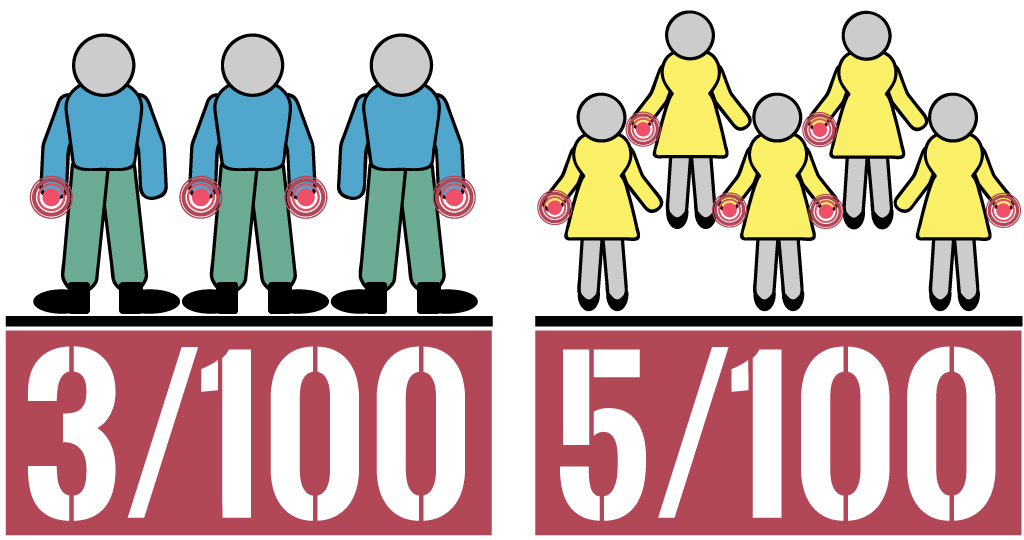
It is a reasonably common disorder in people of working age. According to NHS Choices, about three in 100 men and five in 100 women in the UK experience CTS.
In addition, about 50 percent of pregnant women develop CTS due to the build-up of fluid (oedema) in the tissues of their wrists.
The condition develops gradually over time, and some people tend to dismiss its worsening symptoms as part of aging.
Myth #3:
CTS causes permanent damage to the hands.
Facts:
While CTS may cause permanent damage to the hands if untreated, in most cases careful management of the condition can help regain the full use of hands and eliminate the symptoms.
Myth #4:
Only surgical procedure can resolve CTS once and for all.
Facts:
In most cases, especially where CTS has been diagnosed early, the condition is managed successfully by identifying and eliminating or minimising activities that make the symptoms worse. The patient may need to wear wrist splints overnight.
In more advanced cases, corticosteroid injections are recommended. Carpal tunnel release surgery is carried out only as a last resort, when other methods of treatment have failed to improve the condition.
Myth #5
: Carpal tunnel release surgery is likely to cause long-lasting pain, and will put your hand out of work for a long time. You will probably need physiotherapy to get your hand to heal and work properly after the surgery.
Facts:
While it may have been true in the 1970s and 1980s, it certainly is not the case these days. The procedure usually lasts about ten minutes and is carried out with the use of a local anaesthetic, on an outpatient basis.

In most cases, there is no need for splints or physiotherapy afterwards. The majority of office workers can be back to their duties within a week. Manual workers performing heavy labour may need to allow up to six weeks for the recovery process.
Over 5000 carpal tunnel release procedures are performed in secondary care in the UK annually (the British Orthopaedic Association, Commissioning guide 2013).
All surgical procedures carry some risks, and CT release surgery is no different in this respect. The most common complications may include infection, bleeding after the operation, nerve injury, scarring and persistent wrist pain.
On the whole, however, carpal tunnel release surgery is a relatively low-risk procedure.
Nearly 90% of patients experience significant or at least some improvement following carpal tunnel release surgery.
Author: Joanna Martynka
Date: 16-03-2016
All rights reserved.
Disclaimer:
The information contained in this article is for general information purposes only, and has been provided as is and in good faith. The information is provided by Joanna Martynka and while I endeavour to keep the information up to date and correct, I make no representations or warranties of any kind, expressed or implied, about the completeness, accuracy, reliability, suitability or availability with respect to the website or the information, products, services, or related graphics contained on the website for any purpose. Any reliance you place on such information is therefore strictly at your own risk.


 Jo Martynka